


Page 7 - Racconto dipinti
P. 7
GENESI GREEN
                                                           GENESI GREEN


                                                           AND HOPE
                                                           AND HOPE


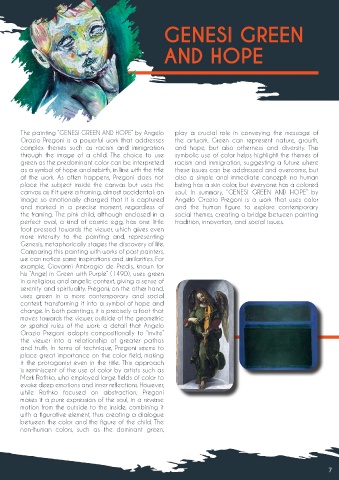
        The painting “GENESI GREEN AND HOPE” by Angelo        play a crucial role in conveying the message of
        Orazio Pregoni is a powerful work that addresses      the  artwork.  Green  can  represent  nature,  growth,
        complex themes  such  as  racism  and  immigration    and hope, but  also otherness  and diversity.  This
        through the image of a child. The choice to use       symbolic use of color helps highlight the themes of
        green as the predominant color can be interpreted     racism and immigration, suggesting a future where
        as a symbol of hope and rebirth, in line with the title   these issues can be addressed and overcome, but
        of the work. As often happens, Pregoni does not       also a simple and immediate concept: no human
        place the subject inside the canvas but uses the      being has a skin color, but everyone has a colored
        canvas as if it were a framing, almost accidental: an   soul.  In  summary,  “GENESI  GREEN  AND  HOPE”  by
        image so emotionally charged that it is captured      Angelo Orazio Pregoni is a work that uses color
        and  marked  in  a  precise  moment,  regardless  of   and  the  human  figure  to  explore  contemporary
        the framing. The pink child, although enclosed in a   social themes, creating a bridge between painting
        perfect oval, a kind of cosmic egg, has one little    tradition, innovation, and social issues.
        foot pressed towards the viewer, which gives even
        more intensity  to the painting and, representing
        Genesis, metaphorically stages the discovery of life.
        Comparing this painting with works of past painters,
        we can notice some inspirations and similarities. For
        example, Giovanni Ambrogio de Predis, known for
        his “Angel in Green with Purple” (1490), uses green
        in a religious and angelic context, giving a sense of
        serenity and spirituality. Pregoni, on the other hand,
        uses  green  in  a  more  contemporary  and  social
        context, transforming it into a symbol of hope and
        change. In both paintings, it is precisely a foot that
        moves towards the viewer, outside of the geometric
        or spatial rules of the work: a detail that Angelo
        Orazio Pregoni adopts compositionally to “invite”
        the viewer into a relationship of greater pathos
        and truth. In terms of technique, Pregoni seems to
        place great importance on the color field, making
        it the protagonist even in the title. This approach
        is reminiscent of the use of color by artists such as
        Mark Rothko, who employed large fields of color to
        evoke deep emotions and inner reflections. However,
        while  Rothko  focused  on  abstraction,  Pregoni
        makes it a pure expression of the soul, in a reverse
        motion from the outside to the inside, combining it
        with a figurative element, thus creating a dialogue
        between the color and the figure of the child. The
        non-human colors, such  as the dominant  green,


                                                                                                                    7

