


Page 13 - Racconto dipinti
P. 13
CREAMY                          T  A    STE
                                                           CREAMY TASTE


                                                           AND FUSION
                                                           AND FUS                     ION


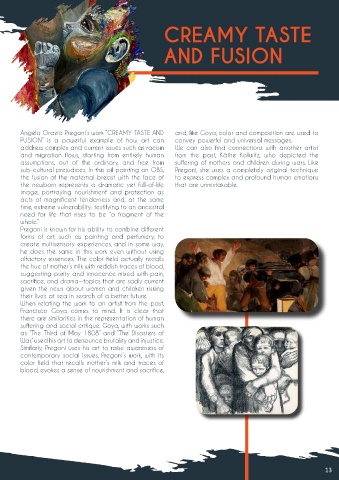
        Angelo Orazio Pregoni’s work “CREAMY TASTE AND        and, like Goya, color and composition are used to
        FUSION” is  a powerful example  of how art can        convey powerful and universal messages.
        address complex and current issues such as racism     We can also find connections with another artist
        and  migration  flows,  starting  from  entirely  human   from the past, Käthe  Kollwitz, who depicted  the
        assumptions, out of the ordinary, and free  from      suffering of mothers and children during wars. Like
        sub-cultural prejudices. In this oil painting on OBS,   Pregoni, she uses a completely original technique
        the fusion of the maternal breast with the face of    to express complex and profound human emotions
        the newborn represents a dramatic yet full-of-life    that are unmistakable.
        image, portraying nourishment and protection as
        acts of magnificent tenderness and, at the same
        time, extreme vulnerability: testifying to an ancestral
        need  for life that rises  to be “a fragment  of the
        whole.”
        Pregoni is known for his ability to combine different
        forms  of art,  such  as  painting  and  perfumery,  to
        create multisensory experiences, and in some way,
        he does the same in this work even without using
        olfactory essences. The color field actually recalls
        the hue of mother’s milk with reddish traces of blood,
        suggesting purity and innocence mixed with pain,
        sacrifice, and drama—topics that are sadly current
        given the news about women and children risking
        their lives at sea in search of a better future.
        When relating the work to an artist from the past,
        Francisco  Goya comes  to mind. It is  clear that
        there are similarities in the representation of human
        suffering and social critique. Goya, with works such
        as “The Third of May 1808” and “The Disasters of
        War,” used his art to denounce brutality and injustice.
        Similarly, Pregoni uses his art to raise awareness of
        contemporary social issues. Pregoni’s work, with its
        color field that recalls mother’s milk and traces of
        blood, evokes a sense of nourishment and sacrifice,


                                                                                                                   13

